 American Physician Institute for Advanced Professional Studies

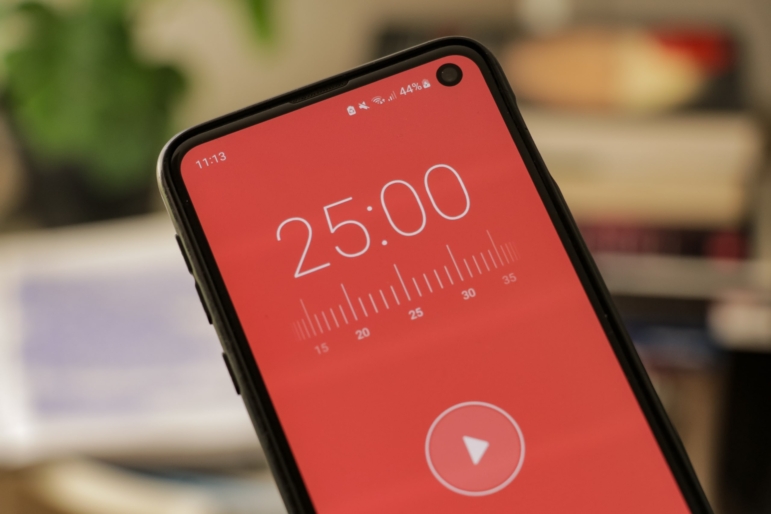
This weekend, among a group of friends, I was asked, “What single thing has most improved your productivity?” My answer was, first, that my productivity these days is not great, and so I’m no paragon of productivity. Second, as far as I spend my time productively, the ‘thing’ that most helps me do so is Counting Units. Let me explain.
Often, my biggest obstacle to completing tasks and projects – whether routine ones like completing work assignments or non-routine ones like advancing a writing project – is getting started. I’m a procrastinator and endlessly avoid opening up the called-for task and simply launching into it. I let myself get overwhelmed by the scope and scale of the task, which looms threateningly in front of me, causing me to run away from it. I’m being dramatic, but procrastinators understand how daunting the resistance to getting started on a task or project is, even on each new part or phase of one. This resistance is then often compounded by a complete lack of interest in the task to be done.
In other words, I succumb to the resistance. The thing I need to do feels too large and complex to even think about. Of course, this framing that occurs in my mind is all BS. The tasks to be done are almost always not all that daunting. Disliked? Not compelling? Sometimes difficult and multistep? Sure. But not insurmountable.
So, my approach of Counting Units is to assign myself ‘a limited engagement’ with that task or larger project. That way, I don’t succumb to the overwhelm.
First Example
Right now, I need to review and give feedback to faculty members on a large number of lectures. I don’t feel like doing it. So, I assign myself a unit of time, quite limited, in which I focus on that task and nothing else, and without distractions.
I use a version of the Pomodoro technique. Pomodoro means tomato in Italian and was named by the man who came up with the approach. He had a kitchen timer at home that looked like a tomato. He realized he could launch himself into work without getting overwhelmed by setting the timer for 25 minutes, working through that duration, and then rewarding himself with 5 minutes of free time. Then he moved on to his second 30-minute Pomodoro cycle and so forth through his work day.
You can assign yourself a set number of Pomodori or a minimum number, which you can exceed once you’re into it. Or, when resistance is at its strongest, you can get going on your first Pomodoro, build momentum, and break through that initial resistance, and only then commit to the number you’ll complete that day. With serious resistance, getting going on a single Pomodoro may be needed to ‘sneak’ past it before committing to the next and then the next Pomodoro.
My Pomodori are 30 minutes long, and I don’t time my in-between breaks because they’re variable. I don’t always even set a timer for the Pomodori because I have developed an intuitive sense of how long 30 minutes feels. I mention this only to stress that you do not necessarily need to follow this or any other productivity technique perfectly, especially when it feels cumbersome and increases the risk of giving up on it. Some people, however, do better with a formal approach because maintaining strictness to the protocol aids in maintaining it over the long haul. This is because, for some people, once a person starts playing loosey-goosey with an approach, it can quickly degrade to the point of uselessness. I, however, have found that moderate adherence to the 30-minute rule works best. Some of my Pomodori are shorter and some longer. I don’t want to stop in the middle of a sentence or a thought, for example. I want to continue until I hit a natural break, and I also make a point of noting my next step so that when I return, I’m not starting off cold. Instead, I have instructions or a launching off item to guide me. (I don’t want to give resistance a chance to creep back in.)
Second Example
I both like and hate exercise. I hate it before I start it, and like it during it and afterwards. I like the burn. So, my issue is simply overcoming the resistance to getting into it.
Here, my Counting Unit is an exercise snack. High-intensity short-interval activity is quite healthy and also helps maintain wakefulness during times of day when a nap seems to be coming on, and alertness and focus when interest is flagging most.
My exercise snacks take only about a minute each. All of them are done to failure: pushups, situps, dead hangs, curls, squats, chair-stepping, and several others that I rotate through.
These exercise snacks work best for me because doing a single exercise to failure takes hardly any time to complete and to recover from. They are so limited in time and effort that they don’t trigger resistance. They also work for me because I can do them in my office or at home. I have been a member of fitness centers in the past. When a member, I’d work out there for a few months to a year before I’d start drifting off and stopping. I’d often end up paying for a membership I stopped using months or years earlier. So, I’ve learned my lesson: If I’m to maintain a workout routine over the long haul, it’s got to be done wherever I happen to be, including when I’m traveling for business or pleasure.
Further, these exercise snacks are so convenient that I can do some during online meetings (such as wrist curls with weights) or even during in-person meetings (such as grip squeezes around a ball or unobtrusive isometric contractions). And, last, I spread these exercises throughout the day and, since they do end up feeling good once I start them, I do get a series of dopamine bursts throughout the day. Since my work now is so sedentary, I really appreciate the burn and the break from sitting on my rearend that these exercise snacks provide me every hour or two.
My minimum number of these exercise snacks is 6 per day. This isn’t a lot since they may add up to 6 minutes of exercise time and about a similar number of minutes of recovery, and they still add up to more exercise than I would do if I weren’t intentional about it or not giving myself a daily minimum. For example, if I do 45-50 pushups – or whatever is my failure number – twice a day, I’m close to doing 100 pushups a day. That’s nothing to be ashamed of, and, of course, this is in addition to whatever other muscle groups my exercise snacks target that day. The only thing I do is keep count during the day of my total exercise snack number of exercise snacks, and I’m done. I don’t like record-keeping.
Third Example
What I’m doing at this moment is writing, writing to you about productivity. I write a lot about a lot of different things, some self-helpy stuff and others of a more serious nature. But I write because it is my way of being, that which is most important to me, that gives me the most pleasure and meaning. But, like is common to most writers, resistance to writing can become intense. So, to overcome it, I give myself one or two writing units to complete each day. Like on this day, I’m writing this blog post. I’ll finish this draft and review/edit it on an upcoming day. And, from the completion of this writing unit, I’ll derive a certain satisfaction. I’ll get my small dopamine burst or reward bonbon that’s like one of those chocolates with the cherry and liquor inside. Since I’m writing this over the weekend, I’ll complete at least one other writing unit later today.
Bringing it All Together
If you do like tracking your activities, then you can be more detailed and conscientious in what you assign yourself and how you record it. Don’t let complex record-keeping become its own source of resistance, though.
Also, my Counting Units is simply what works for me, given my tendency to procrastinate. My larger point is to choose one technique that is simple, easy, and maintainable over the long term – whatever that technique is for you. And then you can always build on that.
I see each day as a gift, one that is unearned yet precious in the utmost. I have a need to rise to the challenge, the value of this gift, by spending it well. In addition to spending it well on or with family and friends, I also want to spend it well through work that produces something of value. In this sense, all of these examples I gave are of work, including the work of exercise that is productive in the sense of producing something of value, adding to my health and wellbeing.
My goal is to hit the sack each night feeling good about my day and my having risen to meet it in a way that befits the enormity of its gift. I am its keeper – as we all are. To be well, I need to steward it well.
Until next time,
Dr. Jack
Today’s Quotes
“The more important a call or action is to our soul’s evolution, the more resistance we feel about pursuing it.” – Steven Pressfield, The War of Art
“You do not rise to the level of your goals. You fall to the level of your systems.” – James Clear, Atomic Habits
“How we spend our days is, of course, how we spend our lives.” – Annie Dillard, The Writing Life
“Procrastination is an emotion-regulation problem, not a time-management problem.” – Timothy Pychyl
“Efficiency is doing things right; effectiveness is doing the right things.” – Peter Drucker





Leave A Comment